


Continuity Built on Record: Why the Osita Ngwu Conversation Is About Performance and Experience
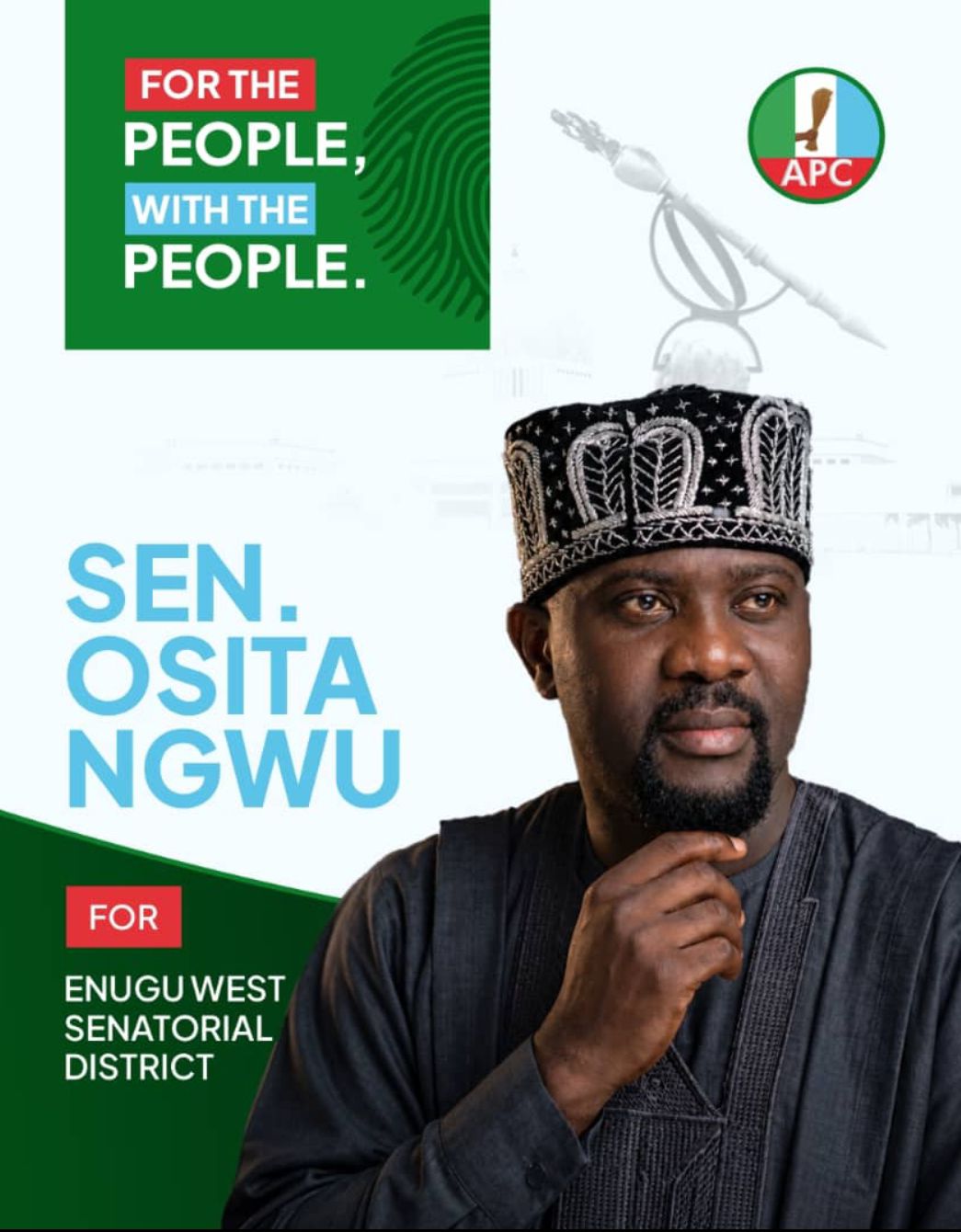

ENUGU WEST — As political conversations ahead of the 2027 elections begin to intensify, the debate around Senator Osita Ngwu, representing Enugu West Senatorial District, is increasingly taking place around two central questions: What has he done with the mandate entrusted to him, and what experience has he gained since entering the Senate?
Those questions are important because Ngwu is no longer a newly elected senator finding his feet in the National Assembly. He entered the 10th Senate after winning the 2023 Enugu West senatorial election and has served as Senate Minority Whip since November 2023. Public profiles also record his earlier professional experience in engineering, oil and gas and business before his move into the Senate.
That background provides the basis for the argument for continuity: a second term would not begin with a new senator learning the workings of the institution, but with an experienced legislator building on an existing record.
From First-Term Senator to Experienced Parliamentarian
Senator Ngwu himself has acknowledged the challenges of being a first-time senator.
In a January 2026 interview with The Sun, he discussed the pressure placed on legislators by constituency projects and explained the distinction between the legislative responsibilities of senators and the executive's responsibility for implementing infrastructure. He also noted that Enugu West contains 81 political wards and about 300 communities, creating significant expectations around constituency interventions.
The Sun Nigeria
That experience matters.
Representation in the Senate involves more than commissioning projects. It involves law-making, motions, oversight, committee work, advocacy and representing constituents within the federal policy-making process.
Ngwu's record therefore deserves to be examined across those different responsibilities rather than judged solely by the number of physical projects in individual communities.
A Legislative Record to Examine
According to a publication on Ngwu's official platform, bills credited to him include proposals dealing with health infrastructure, private investigation, maritime operations, entrepreneurship development, public procurement, agricultural research, national planning, virtual assets and cryptocurrency regulation, and federal medical-centre legislation.
The list is significant because it demonstrates the range of issues around which he has participated in the legislative process.
Among the publicly listed proposals are:
Health Infrastructure Development Agency (Establishment) Bill
National Entrepreneurial Development Institute Bill
Public Procurement Act (Amendment) Bill
Agricultural Research Council of Nigeria Act (Amendment) Bill
National Planning Commission Act (Amendment) Bill
Nigeria Virtual Assets and Cryptocurrency Regulation Bill
Federal Medical Centre Act (Amendment) Bill
These bills should, of course, be assessed according to their legislative status and eventual outcomes—not merely because they were sponsored. But their presence on the record provides voters with something concrete to examine when evaluating Ngwu's legislative activity.
Education as a Constituency Priority
Education is another area where publicly reported figures provide measurable points for discussion.
Ngwu's official scholarship platform states that more than 715 scholarships have been awarded across Enugu West, covering categories including merit, special recognition, indigent support, master's and PhD studies and international scholarships.
A separate 2026 report reviewing his first three years in office also reported substantial educational interventions, including examination support and educational materials for pupils across the senatorial district.
For a constituency spanning Udi, Ezeagu, Oji River, Awgu and Aninri, educational support can be particularly important because its impact is measured not only in infrastructure but also in opportunities created for students.
Infrastructure, Water and Community Development
A 2026 review of Ngwu's representation reported interventions involving roads, bridges, water projects, solar-powered boreholes and other community infrastructure across Enugu West.
Among the projects identified in that report were the Egede Rural Market and Access Road, Umuavulu-Enu Abor Road with solar street lights, Agbo-Ozegu-Umoji-Afor Igwe Road, portions of the Umuabi Greater Umuneke Ring Road, Iwollo Road and the Amaguani Amagu/Ubenegu Amokwe Link Bridge in Oduma.
Water interventions were also reported, including the Greater Ngwo Water Reticulation Project, Nkwe Water Scheme and Okwojo Pump House, alongside solar-powered boreholes in different communities.
These claims should be matched against project documentation, locations and implementation status by constituents. That is precisely what a performance-based political conversation should encourage.
A Record That Includes Oversight
Ngwu's role is not restricted to constituency development.
In June 2026, the News Agency of Nigeria (NAN) reported that Ngwu, as a member of the Senate Committee on Works, participated in the inspection of major federal road projects in Enugu State, including sections of the Enugu-Port Harcourt Expressway, Enugu-Onitsha Expressway, Eke Obinagu Flyover and Abakpa Junction Bridge. NAN reported his statement that the committee had monitored the Eke Obinagu project from its beginning.
This illustrates another dimension of representation: legislators can influence public infrastructure through oversight, committee participation and engagement with implementing agencies, even where they are not the contractors executing the projects.
Youth Empowerment and Economic Opportunity
Another reported component of Ngwu's constituency programme is youth and economic empowerment.
A 2026 review reported training initiatives in areas including digital technology, cybersecurity, entrepreneurship and vocational skills, alongside grants and equipment. It also reported the distribution of more than 56 mini-buses and trucks in 2025 as part of an empowerment initiative.
The significance of such programmes should ultimately be measured by their beneficiaries: who received support, what was provided, whether the beneficiaries can sustain their businesses and whether the interventions generated measurable economic value.
Why Experience Is Now Part of the Conversation
This is perhaps the strongest factual basis for the continuity argument.
In 2023, Ngwu was a first-time senator.
By 2026, he had accumulated experience within the 10th Senate, served in a principal minority leadership position, participated in Senate committees and developed a legislative and constituency record.
That institutional experience cannot simply be recreated overnight.
The question for voters therefore becomes one of continuity versus change in representation—and the relevant evidence is the senator's record between 2023 and 2026.
The Enugu West Test: Record, Results and Accountability
Supporters of Senator Osita Ngwu can legitimately point to his legislative proposals, leadership position, scholarship programmes, infrastructure interventions, empowerment initiatives and oversight activities as evidence of work undertaken during his first term.
But responsible political journalism should go one step further.
Every major claim should be subjected to three questions:
What was promised?
What was actually delivered?
What measurable difference has it made?
That is the standard that should guide the 2027 conversation.
For Ngwu, the argument for continuity is therefore not simply about slogans or party politics. It is about whether constituents believe the combination of legislative experience, constituency interventions, institutional knowledge and ongoing projects provides a foundation worth building upon.
Continuity Is Ultimately About What Comes Next
The case for continuity, as presented by Ngwu's supporters, is straightforward: the first term established a foundation; additional time in office would provide an opportunity to consolidate and expand it.
Whether constituents accept that argument is ultimately a matter for them to determine based on the evidence available to them.
But one thing is clear: the conversation about Senator Osita Ngwu in Enugu West now has a substantial record to examine.
His 2027 campaign can therefore be framed not merely around “give me another term,” but around a more concrete proposition:
Look at the legislative record. Examine the projects. Verify the interventions. Assess the experience gained. Then decide whether continuity is justified by the results.
The Record Is the Message
For supporters, the message is simple:
Osita Ngwu's first term has created a record. His experience has grown. His legislative footprint has expanded.
His constituency interventions are on record.
The 2027 conversation, therefore, is increasingly about what Enugu West wants to do with that experience.
Continuity built on record. Experience built in office. Representation measured by results.
Vox Populi, Vox Dei.
Leave a Reply
Your email address will not be published. Required fields are marked *




.jpg)